

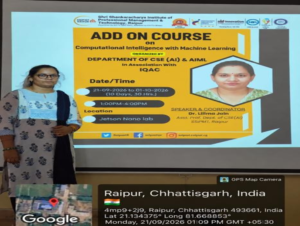
The Department of CSE (AI) & AIML at Shri Shankaracharya Institute of Professional Management & Technology (SSIPMT), Raipur, in association with IQAC, organized a 10-day add-on course on “Computational Intelligence with Machine Learning.” It ran in person from 21 September to 1 October 2026, from 1:00 PM to 4:00 PM each day, at the Jetson Nano Lab in the Academic Block. In total, 34 students completed the 30-hour programme.
The course was designed to give students practical knowledge of computational intelligence and machine learning techniques for real-world problems. Dr. Lilima Jain, Assistant Professor, Department of CSE (AI), served as both speaker and faculty coordinator. Her work covers AI/ML, cybersecurity, Software-Defined Networking and programmable data plane technologies.
Days 1-3: Foundations
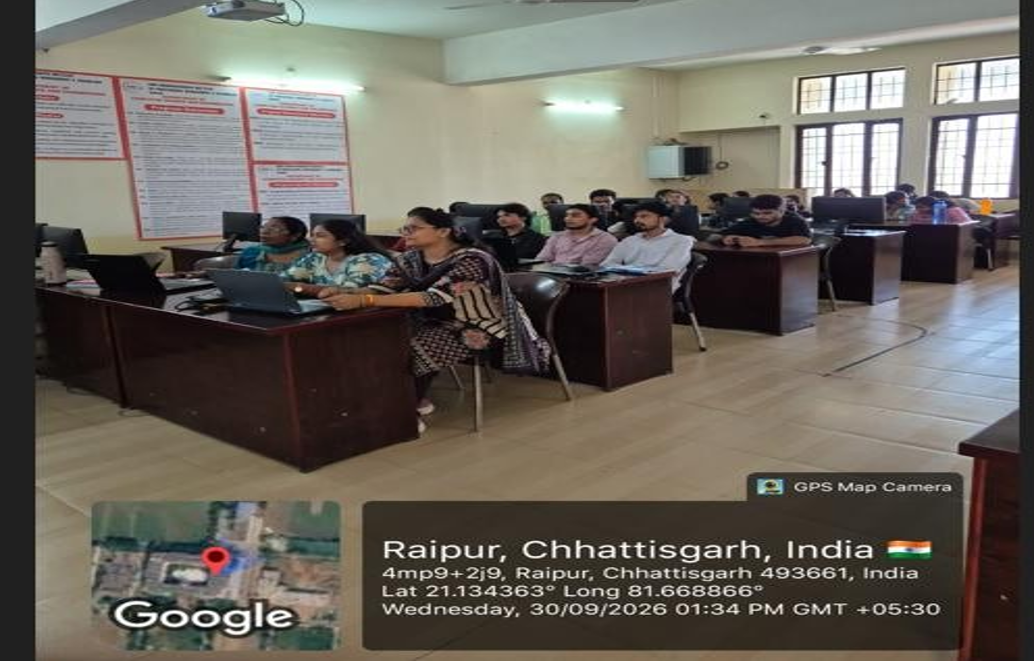
The course began on 21 September with an introduction to computational intelligence, AI and machine learning, their applications, and Python environment setup. On Day 2, students worked through Python fundamentals and data types (variables, lists, tuples, sets, dictionaries) and practised with NumPy and Pandas. Day 3 covered data preprocessing and visualization, including cleaning, handling missing values, encoding, normalization and scaling, through dataset exercises.
Days 4-6: Core Computational Intelligence Techniques
Day 4 (24 September) focused on fuzzy logic: fuzzy sets, membership functions, rules, fuzzification, inference and defuzzification. On Day 5, students studied artificial neural networks, including the perceptron, activation functions, multilayer networks and backpropagation, and trained and evaluated their own models. Day 6 (26 September) introduced evolutionary computation, with hands-on genetic algorithm and optimization exercises covering selection, crossover, mutation and PSO.
Days 7-8: Machine Learning and Mini Projects
After the Sunday break on 27 September, Day 7 (28 September) covered supervised and unsupervised learning, with classification, regression, clustering and model evaluation exercises. On 29 September, students began developing mini projects, from problem identification and dataset selection to preprocessing, model building and evaluation, with faculty mentoring.
Days 9-10: Project Presentations
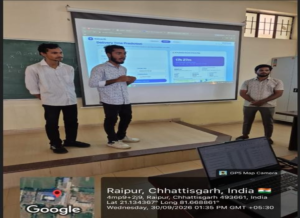
Mini project presentations were held on 30 September and 1 October. Students presented their problem statements, methodology, implementation and results, and defended their work in front of faculty. One team presented a delivery time prediction application. The course ended with evaluation, feedback and a concluding session.
Participants gained skills in Python programming, data handling and preprocessing, fuzzy logic, neural networks, evolutionary algorithms and supervised and unsupervised learning. They also learned to evaluate models using accuracy, precision, recall and F1-score, and to combine these techniques in a working project. The course emphasized practical implementation, problem-solving and technical communication, with applications in IoT, cybersecurity, healthcare, networking and smart systems.
